Adaptive Capability Helix
Capability grows at the Learning Edge
The Adaptive Capability Helix Framework describes how individuals and organisations develop capability in complex, high-attention and performance environments.Capability expands through repeated cycles of experience, reflection, and integration at the Learning Edge - where environmental load approaches the limits of current regulation capacity.
The Adaptive Capability Helix Model
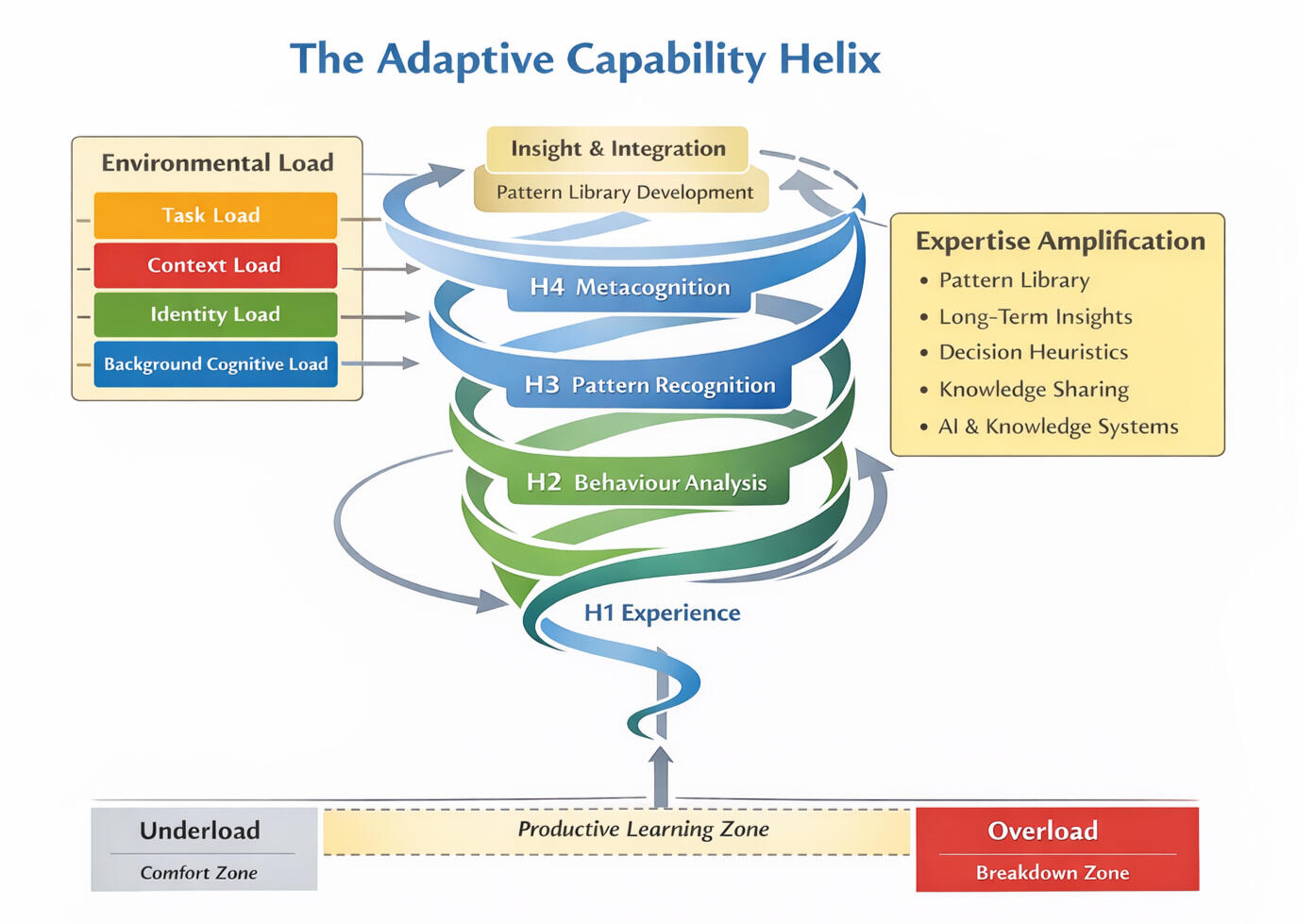
The Adaptive Capability Helix describes how capability expands through repeated cycles of challenge, reflection, and integration.
*Working model (v1.4 March 2026)Developed from practical observation of learning in high-attention environments, including flying training, advanced motorcycle instruction, and situations demanding high performance under pressure. Current applications include one to one and team based training, leadership development, and wider organisational learning initiatives where demand is high.
Core Concepts
The Adaptive Capability Helix Framework and Model describe how capability develops when individuals operate near the boundary between environmental demands and their ability to regulate performance.
Adaptive Capability Helix
The Adaptive Capability Helix describes how human capability expands through repeated cycles of challenge, reflection, and integration.Rather than developing in a straight line, individuals encounter destabilising situations that stretch their current capacity. When these experiences are followed by reflection and insight, new patterns of understanding are integrated into future behaviour.Over time this process gradually expands the individual’s ability to remain effective under increasing levels of environmental pressure. Each cycle builds upon the previous one, creating a spiralling trajectory of capability development.The helix therefore represents the gradual expansion of judgement, adaptability, and decision-making capacity as individuals learn to operate in increasingly complex environments.
Environmental Load
Environmental Load refers to the total pressure experienced by an individual in a given situation. This pressure is not limited to the task itself. It may include the inherent complexity of the work, organisational expectations, time constraints, social pressures, and the background cognitive load created by modern information environments.These interacting factors combine to shape the overall demands placed on the individual’s attention, judgement, and emotional regulation. In complex environments, environmental load can fluctuate rapidly as conditions change.Understanding this total load is important because capability development does not occur in isolation from these pressures. It emerges through the interaction between environmental demands and the individual’s capacity to regulate themselves while performing.
Regulation Bandwidth
Regulation Bandwidth describes the individual’s capacity to maintain effective performance under pressure.It includes the ability to manage attention, process information, regulate emotional responses, and adapt behaviour as conditions change. Every individual operates within a finite bandwidth.When environmental demands remain comfortably within this capacity, performance is stable but little new capability develops. As demands increase and approach the boundary of regulation capacity, the individual begins to experience destabilisation.These moments reveal the limits of current capability and create opportunities for adaptation. Over time, successful learning cycles expand regulation bandwidth, allowing individuals to remain effective under increasingly complex or demanding conditions.
Learning Edge
The Learning Edge is the boundary where environmental load approaches the limits of an individual’s regulation bandwidth.In this zone, performance begins to feel uncertain or unstable, but the individual retains enough control to remain engaged with the task.These moments often trigger experimentation, reflection, and the search for new strategies. When individuals operate too far below this boundary, work becomes routine and learning slows. When demands exceed regulation capacity entirely, overload occurs and performance deteriorates.The Learning Edge therefore represents the narrow region where meaningful capability development becomes possible. Effective learning environments help individuals encounter this boundary repeatedly while preventing collapse.
Reflective Cycle (H1-H4)
Capability development depends not only on experience but on reflection.The reflective cycle describes four stages through which experience becomes learning. H1 involves direct experience of a situation. H2 examines behaviour and the decisions taken. H3 identifies patterns across multiple experiences, revealing recurring signals and relationships. H4 develops metacognitive awareness of how decisions are made and how judgement evolves.Each stage deepens the individual’s understanding of the environment and their own responses within it. When these reflective cycles repeat over time, individuals gradually organise their experiences into structured patterns that support more confident and effective decision-making in future situations.
Pattern Library Development
Through repeated cycles of experience and reflection, individuals gradually build an internal pattern library. This library consists of accumulated mental models linking situations, cues, decisions, and outcomes.Rather than relying solely on explicit rules or procedures, experienced practitioners draw on these patterns to interpret complex situations quickly and effectively. Pattern libraries allow subtle signals to be recognised earlier and decisions to be made with greater confidence.Expertise therefore develops not simply through time spent performing tasks, but through the organisation of experience into meaningful patterns.As pattern libraries grow, individuals become better able to anticipate developments and respond appropriately in unfamiliar or rapidly changing environments.
Expertise Amplification
Expertise Amplification describes the process through which individual expertise becomes shared capability within an organisation.In many environments, valuable insights remain embedded within the experience of individual practitioners.When these insights are articulated, interpreted, and shared, they can contribute to the development of others. Mechanisms such as mentoring, reflective discussion, and knowledge systems help extend individual pattern libraries across teams.Modern tools, including AI-supported knowledge systems, may further accelerate this process by capturing patterns, decision heuristics, and accumulated insights.When expertise is amplified in this way, organisations can strengthen collective capability rather than relying solely on isolated individual experience.
Working Paper v1.4
Download a short paper describing the Adaptive Capability Helix model and its potential applications in training, leadership development, and organisational learning.
Working Paper - Version 1.4
(March 2026)
The Adaptive Capability Helix: A conceptual framework for capability development in complex environments.This paper introduces the Adaptive Capability Helix framework and will continue to evolve as further applications are explored.